
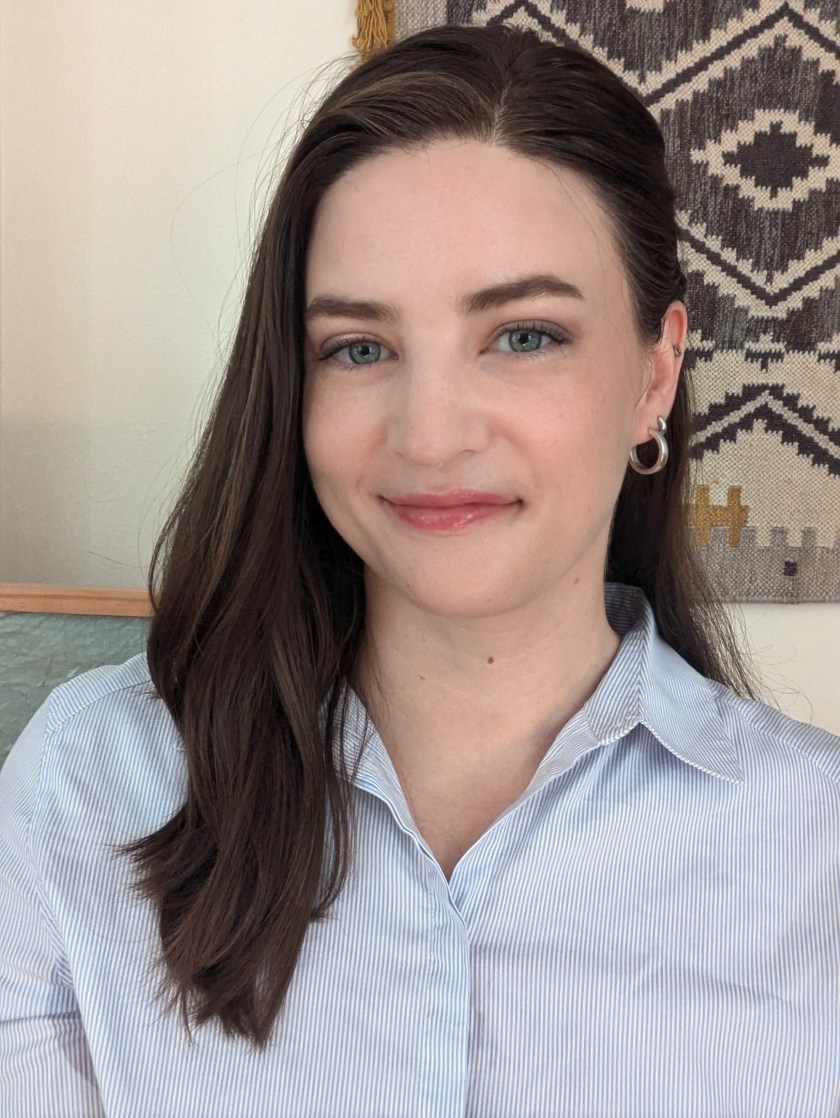
Shannon Bewley is an art historian whose research focuses on twentieth-century public sculpture commissions. She draws on newspaper reports, community interviews, and institutional archives to situate artists’ careers within the professionalization of arts administration, and state, federal, and international public funding for the arts. Her commitment to public art is anchored to her upbringing in Birmingham, Alabama, where living amid sculptures like the monumental cast iron Vulcan, and abstract and figurative Civil Rights memorials provided foundational experiences for her research and pedagogy.
She is currently a PhD Candidate in the History of Art & Architecture at Boston University. Her dissertation, to be defended in Spring 2026, is titled “Earth Artists, Ancient Earthworks, and Land Reclamation Sculpture in the United States from 1965 to 1985.” This project discusses land reclamation sculpture, or commissions of earthen sculpture that rehabilitate industrial wasteland and abandoned mines into sites that function as both public parks and works of art. Expanding the well-researched sculptural style of earth art, she explores the specific social, political, and administrative context in which the convergence of federal arts patronage and environmental policy enabled suburban municipal agencies to commission such sculptures from major American sculptors Robert Smithson, Robert Morris, and Michael Heizer. Despite the artists’ different opinions about using art to ameliorate resource extraction, they each incorporated the imagery of ancient, Native, and Indigenous earthworks into their land reclamation sculptures. Bewley contextualizes the artists’ interest in earthworks at the intersection of American national identity and archaeology, environmental concerns, and the perception of Native people in popular culture. The artists’ tourism trips to view petroglyphs, burial mounds, performances, and temples in the United States, Mexico, Peru, England, and the Netherlands are considered as re-enactments of longstanding settler colonial traditions of exploration, excavation, and travelogue—a tradition that lives on in countercultural novels, family vacations, and national parks. All free to the public today, the land reclamation sculptures illustrate the potential of interdisciplinary public art to offer both aesthetic experience and community space, while attesting to the historic importance of Native and Indigenous earthworks to the development of American visual art and identity in the twentieth century.
Bewley has taught a variety of undergraduate courses at universities in the Boston area: Suffolk University, Simmons University, and Boston University. Emphasizing gender and postcolonial methodologies amid global exchange, her undergraduate course topics span visual culture from the fifteenth century to today, and include writing seminars on the topics of Native American and African American art history. Considering diverse and global narratives, her pedagogy emphasizes professional writing skills through assignments that relate to students’ lived experiences with contemporary art.
Commitment to supporting diversity and inclusion leads in her professional and pedagogical service. Bewley led the fundraising and organization of the doctoral student symposium African American Art History: Present Coordinates in 2022. The symposium featured presentations by five international doctoral candidates with a keynote given by Melanee Harvey, PhD, introduced by Patricia Hills, PhD. Alongside Colleen Foran, Bewley organized the 40th-anniversary Mary L. Cornille (GRS’87) Graduate Symposium in the History of Art & Architecture in Spring 2024. Previously, Bewley published four open access volumes of the scholarly art history graduate student journal SEQUITUR as Senior Editor.
Prior to entering Boston University, Shannon Bewley held a variety of curatorial, research, and registration roles at her hometown museum, the Birmingham Museum of Art in Alabama. She was the inaugural Provenance Research Fellow and intensively researched the historic sale, publication, and exhibition histories of eighty collection highlights from the American and European painting collections. Her research, available on the museum’s website, better recorded and contextualized the narratives of the collection for both general audiences and academic researchers. As a Registrar’s Assistant, she managed the digitization and cataloging of more than 1,000 exhibition archives dating from 1951 to 2006. She remains connected to the visual arts in Alabama and serves on the Visual Arts Grant Advisory Panel of the Alabama State Council of the Arts.
Bewley earned a BA in Art History and a BFA in Studio Art (Sculpture) from Auburn University, graduating summa cum laude from the Honors College in 2017. Her award-winning studio art practice engaged a high level of craft in woodworking and welding (photographs of these works can be seen in this website’s header). In 2015, she was awarded a U.S. Department of State’s Benjamin A. Gilman International Scholarship. For four years, she was the primary art handler and photographer for more than thirty-five exhibitions at Biggin Gallery in Auburn, Alabama. Her experience as a professional artist and preparator informs her research attention to the material logistics and the interagency coordination required to create public art.
 Shannon Bewley
You must be logged in to post a comment.